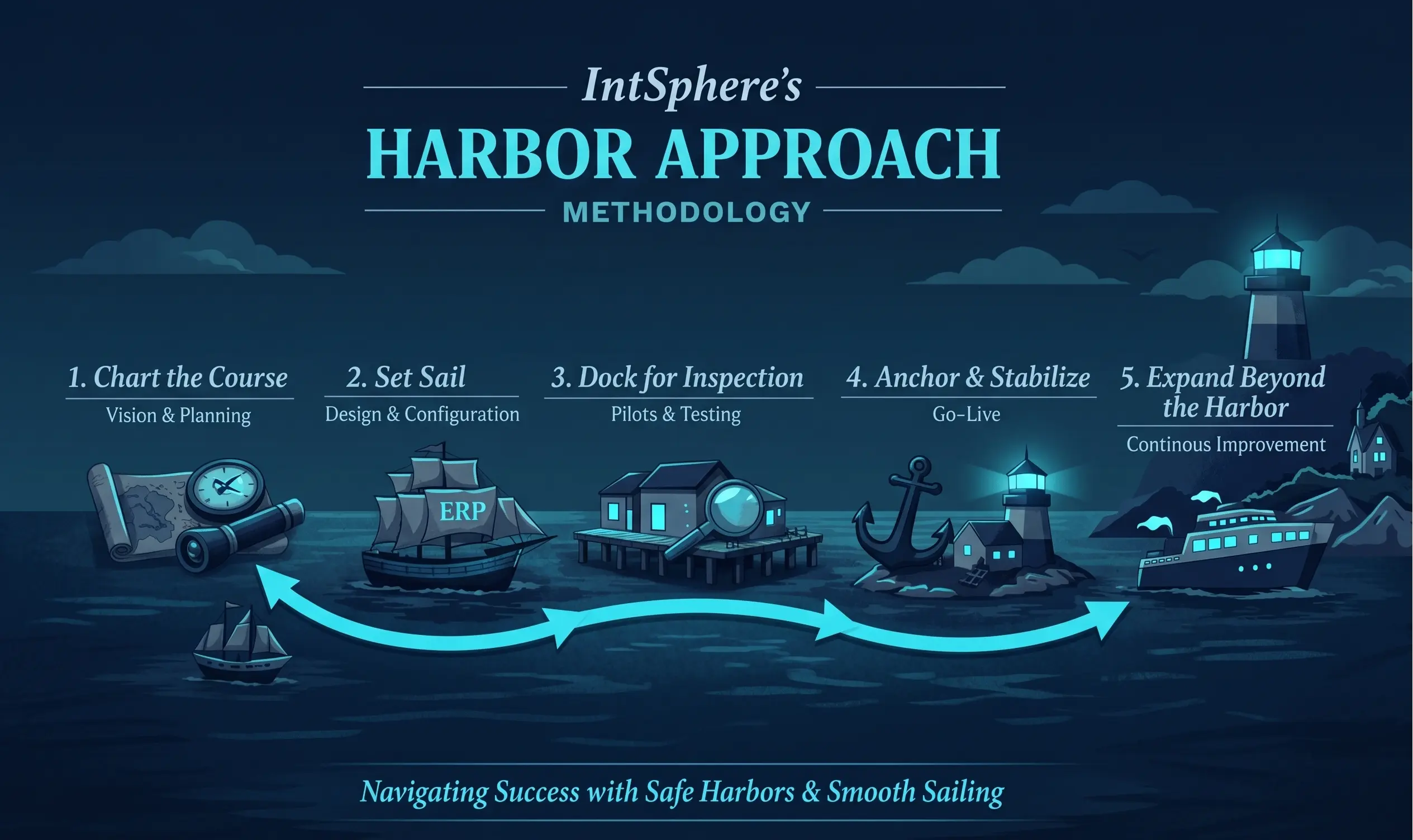
Navigating ERP Transformation
Unlike traditional waterfall or purely agile ERP methodologies, IntSphere's Harbor Approach blends structure with adaptability. It ensures organisations don't rush into go-live without stabilising each stage — while still allowing iterative improvements at every checkpoint.
Checkpoints
Governance Coverage
Beyond Go-Live
The Voyage, Stage by Stage
Each phase is a harbor checkpoint — a deliberate pause to validate, stabilise, and prepare before the next leg of the journey.
- Define the destination harbor: strategic business outcomes such as finance automation, supply chain resilience, and compliance.
- Establish KPIs and transformation goals as navigational charts.
- Assemble the crew — project team, stakeholders — and set governance structures.
- Ensures full clarity of purpose and direction before setting sail.
- Configure ERP modules — Oracle ERP Cloud — aligned to the planned business route.
- Conduct fit-gap analysis to ensure the solution matches the journey ahead.
- Begin integrations and reporting setup — the sails that catch the wind and drive momentum.
- The ERP blueprint is finalised and agreed before build begins.
- Conference Room Pilots (CRPs) act as docking points to validate alignment with business processes.
- Playback sessions serve as inspections — ensuring every process is seaworthy before departure.
- Gaps and risks are identified and addressed before the ship leaves the dock.
- Testing and validation stabilise the voyage and reduce go-live risk.
- Deploy ERP Cloud and drop anchor — stabilising operations in the new system harbor.
- Intensive focus on adoption, training, and post-go-live stabilisation.
- Ensure systems are secure and processes reliable before exploring new capabilities.
- Data migration and cutover are carefully managed to avoid disruption.
- Once anchored, prepare for new voyages — innovation, automation, and AI integration.
- Adapt to Oracle's quarterly updates as changing tides — proactively, not reactively.
- Scale ERP capabilities across regions, business units, or new modules.
- Continuous improvement prepares the enterprise for new horizons and competitive advantage.
The Harbor Approach is both structured and narrative-driven: it provides the rigour of phased ERP implementation while engaging stakeholders with a metaphor that keeps everyone aligned on the journey.
Built for Real ERP Journeys
The Harbor metaphor isn't just storytelling — each element maps to a proven implementation principle that reduces risk and drives adoption.
Memorable Storytelling
The harbor metaphor makes complex ERP phases easy to grasp — for executives, project teams, and end users alike. Everyone understands the journey.
Strategic Clarity
Each harbor checkpoint ensures safe transitions and minimises risk. No phase begins before the previous one is fully validated and stabilised.
Adoption Focus
Training and change management are embedded throughout the voyage — not bolted on at the end. User adoption is treated as a first-class deliverable.
Future Readiness
Continuous improvement prepares the enterprise for new horizons — AI, automation, and scale — without disrupting the stable core.
Strong Governance
Executive oversight is built into every phase, keeping the project aligned with business goals and enabling rapid course corrections when needed.
Structure Meets Agility
Rigorous phase gates prevent premature go-live, while iterative pilots and playbacks allow continuous refinement — the best of both worlds.
Harbor vs. Waterfall vs. Agile
The Harbor Approach is not a rebrand of existing methodologies — it synthesises the best elements of both while addressing their key weaknesses in ERP contexts.
Traditional Waterfall
- Linear — hard to course-correct mid-journey
- Late testing increases go-live risk
- Change management often an afterthought
- Governance is front-loaded, not sustained
- Post go-live improvements are slow
Purely Agile
- Can lack the rigour required for enterprise ERP
- Sprint cycles can defer critical integration work
- Stakeholder alignment harder to sustain
- Data migration often underestimated
- Scope creep risk in complex ERP landscapes
Harbor Approach
- Phased checkpoints — validate before progressing
- CRPs & playbacks catch gaps early
- Change management woven into every phase
- Governance sustained throughout the voyage
- Continuous improvement built into Phase 5
Ready to Chart Your Course?
Talk to our team about applying the Harbor Approach to your Oracle ERP implementation.